Craster Village
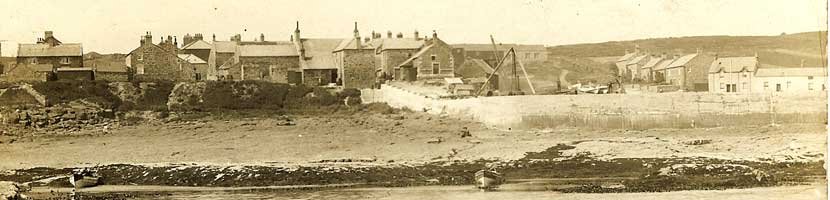
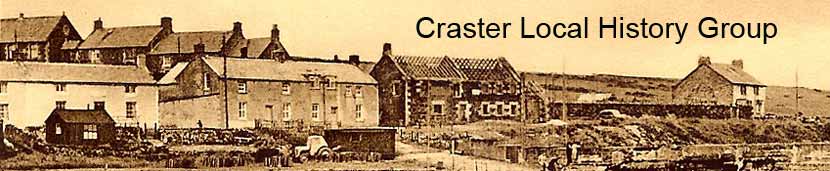
The village of Craster on its current site was started in the late 18th century. Earlier, there was settlement in the fields to the east of Craster Tower. The 'old' village is defined by the whinstone construction of the buildings. The first houses of the council estate south of Church Street, now many owned privately, were built in 1937; before that time the area was farmland. The modern terrace of houses on the northern end of Dunstanburgh road were built in the 1950's.
Mary Craster, in 'We Can Mind the Time' wrote...
"...until the late 18th century, Craster village was still at the top of the hill, immediately north and east of Craster Tower. A map of 1723 shows an E-W road with 12 houses in 2 rows on each side of it still to be seen in the pasture, running straight down the bank next to the Tower. The present road did not exist and there was nothing by the sea apart from the little cove where the fishing boats were beached."
"George (Craster), married Olive Sharpe, daughter of a neighbour at Gray's Inn and in 1760 they set off on an extended Grand Tour of Europe; South France, Rome, Florence, Venice and back to Paris. On their return they decided to enlarge and modernise Craster Tower, building a Georgian wing with pedimented front door on the South courtyard. A kitchen-garden was also constructed with its North wall backing onto a row of cottages at the southern edge of Dunstan (thus warming the garden wall). These form the present Cottage Inn. The Summer House on the SE point of Craster haven was also built as a picnic house for the Craster family."
Of Shafto Craster she wrote:
"He built the school in Dunstan and laid out tree plantations round the Tower gardens. He it was that completed the removal of the village to the sea. It was known as Craster Seahouses as late as 1828. In 1822 he built Craster Square on the hill behind where Robson's Yard now is, as housing for the fishermen. This was pulled down in 1962. A water reservoir was also built and coastguards' cottages (the castellated) building on the hill above Bark Pots tea rooms.
The road past the Tower on the North side of the house was moved further away, making the Avenue, from the Pillars at the new cross-roads and leading through the sham Gothic archway and down the bank."

"Reproduced from the 1897 Ordnance Survey map with the kind permission of Ordnance Survey" |
The History of Northumberland, Ed. Bateson, 1892, has the following...
"...the village of Craster, standing upon the shore where an indentation in the rock forms a natural haven for the cobles of the fishermen. Two limestone islets, the Little Carr to the north and the Muckle Carr to the south, act as a natural breakwater, and render the haven a
safe anchorage except in very boisterous weather. A small
stream which finds its way through a gap in the heugh
divides the village into two parts, known as the 'north
side' and 'south side.' The inhabitants, no longer so numerous as formerly, maintain
themselves chiefly by fishing, and have many characteristics which distinguish them from the agricultural people of the neighbouring villages. A stranger will receive a pleasing impression from the fisherfolk. He will observe their fine physique, their
rugged but handsome features, and the peculiar softness of their speech. These traits, in some measure due to the simple and healthy occupation of the people, have been developed by their manner
of life. The similarity of their names (and it would be hard to find a Craster man who is not an Archbold or a Simpson) shows that the inhabitants of Craster, as of other fishing villages along the coast of Northumberland, are a colony apart."
In the same volume the following Census Returns are given:
1801
100
1851
222 |
1811
118
1861
216 |
1821
146
1871
217 |
1831
212
1881
272 |
1841
247
1891
197 |
It notes: "The diminution is due to the decrease of the agricultural part of the population. The size of the township is 648 acres." This remark presumably refers to the decline between 1881 and 1891, a decline of 28%. |